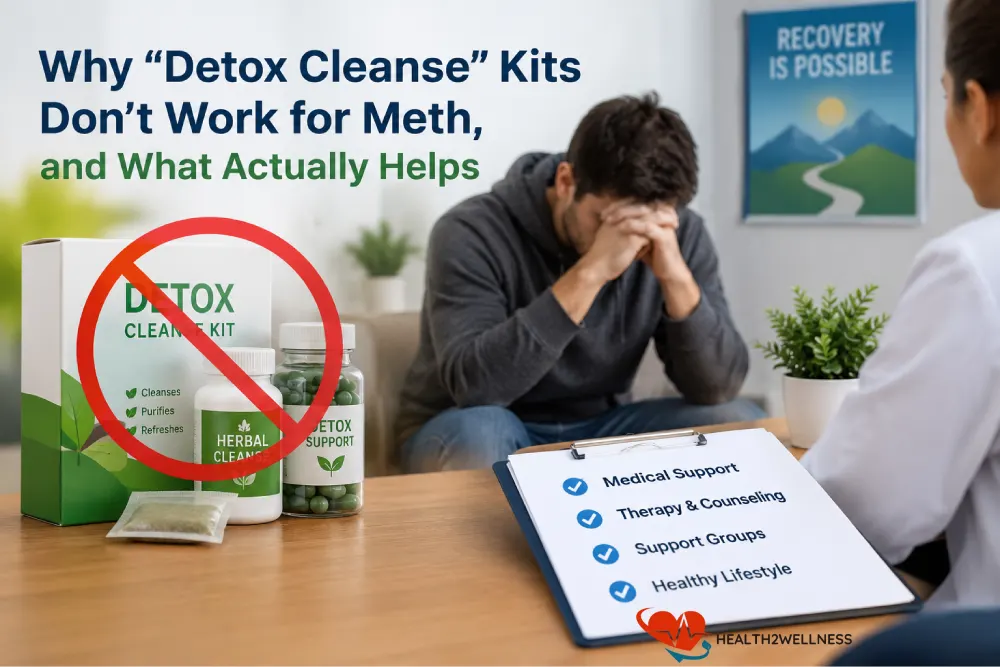
Search online for a way to get meth out of your system fast and you’ll find no shortage of answers. Detox teas. Cleansing drinks. Herbal capsules with confident labels and five-star reviews. Some promise results in 24 hours. Most of them quietly suggest you’ll never need to see a doctor.
It’s easy to understand the appeal. People look for these products because they’re scared, because they want privacy, because they’ve got a drug test coming up, or because walking into a clinic feels impossible. A product you can order to your door feels like control. Unfortunately, the evidence says it isn’t.
Table of Contents
What “detox” and “cleanse” products actually are
The National Center for Complementary and Integrative Health (NCCIH), part of the US National Institutes of Health, reviewed this whole category in its fact sheet on detoxes and cleanses (updated March 2025). These programs can include fasting, juice-only diets, supplements and herbs, colon cleansing and saunas, usually with claims that they remove toxins or improve health.
NCCIH’s verdict is blunt. It notes that only a small number of human studies exist, and that “the studies themselves have been of low quality.” It cites a 2015 review that found no convincing research supporting detox diets for removing toxins, and points out that there have been no studies at all on the long-term effects of these programs.
That research is about general “detox” products, not drug-specific ones. But if detox teas and cleanses haven’t been shown to work for the everyday toxins they’re usually marketed against, there’s no reason to think a kit will safely clear a powerful stimulant from someone’s body or ease what comes after.
Some cleanses carry their own risks
The products aren’t only ineffective. Some can do harm. NCCIH warns that “some ‘detoxification’ or ‘cleansing’ programs can be unsafe and falsely advertised.” It lists several risks:
- Products containing hidden ingredients that aren’t on the label
- Laxative-based cleanses causing diarrhea and dehydration
- Fasting combined with large amounts of water or herbal tea leading to dangerous electrolyte imbalances
- Colon cleansing causing serious side effects, especially for people with heart, kidney or digestive conditions
The US Food and Drug Administration and Federal Trade Commission have both taken action against companies selling detox and cleansing products, according to NCCIH, including for hidden ingredients and false claims to treat serious diseases.
Now picture someone coming down from meth, who may already be exhausted, dehydrated, not eating and not sleeping. Adding a laxative tea or a multi-day fast to that situation isn’t a cleanse. It’s an extra strain on a body that’s already under pressure.
The hard part isn’t “toxins”
Much of the marketing assumes that the problem is something left in the body that needs flushing out. For many people who stop using meth, that’s not how it feels at all. The difficult part tends to be what’s going on in their head and their energy levels: crushing tiredness, low mood, irritability, poor sleep, strong cravings and a sense that nothing feels good anymore.
No tea fixes that. What helps is support from people who understand what’s happening, a safe place to rest, someone keeping an eye on physical and mental health, and a plan for the weeks after the first few days.
That’s also why the most important thing a “quick detox” product does is often the most dangerous: it convinces someone they don’t need to talk to anyone. For a clear look at the warning signs and what to do instead, this breakdown of so-called detox cleanses for meth walks through why medical support matters and when someone needs help urgently.
Signs someone needs medical help right away
Stopping meth can be physically and emotionally risky, especially after heavy or long-term use. Call 911 or go to an emergency department if someone has:
Chest pain or a racing, irregular heartbeat. Severe confusion, paranoia or hallucinations. Thoughts of harming themselves or others.
If you’re worried about someone’s safety and they won’t go, stay with them and call for help anyway.
What a better first step looks like
If the real worry is a drug test at work or for a custody hearing, a cleanse isn’t the answer there either. Being honest with a doctor or a treatment provider about what’s going on usually opens more doors than a failed attempt to hide it, and many employers have confidential support routes for exactly this situation.
You don’t need a crisis to justify reaching out. A doctor, an urgent care clinic or a treatment provider can talk through options confidentially and without judgment. In the US, SAMHSA’s National Helpline at 1-800-662-4357 offers free, confidential treatment referral and information around the clock.
If you’re supporting someone else, it helps to stay calm, avoid lecturing, and focus on getting them to a safe place and a proper assessment. People rarely respond well to being told what they did wrong. They usually respond better to someone asking what they need.
If you or someone you love is thinking about suicide or self-harm, call or text 988 to reach the Suicide and Crisis Lifeline.
The shortcut that isn’t one
Detox kits sell the idea that recovery can be quick, private and done alone. The truth is less convenient but far more hopeful: getting through the hardest days is safer with other people involved, and nobody has to start that process with a tea.
Why "Detox Cleanse" Kits Don't Work for Meth, and What Actually Helps