
Most stress advice tells you to do less. Sit still. Breathe. Put the phone down. Quiet the mind. Some of that helps, some of the time. But for a surprising number of people, the thing that actually shifts their stress levels isn’t subtraction at all. It’s the opposite. It’s putting their full attention into a physical task they can’t half-do. I not talking about just ‘keeping busy’ to avoid feeling emotions though, I mean doing something practical, with your hands. Making. Creating.
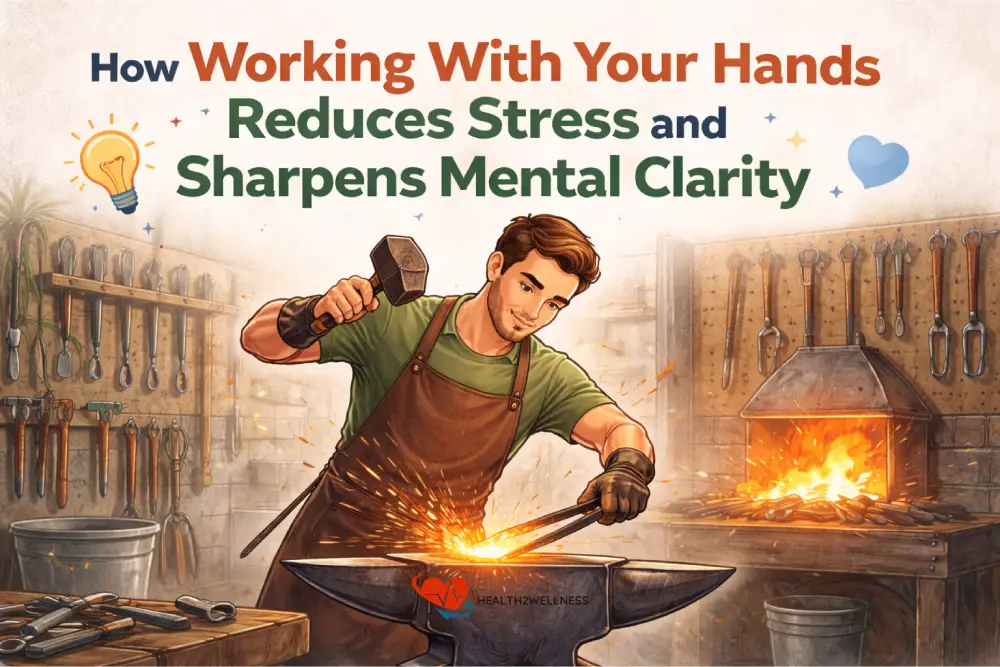
I run a forge in Stroud called Soulful Iron, and I see this play out in front of me on a fairly regular basis. Sometimes people arrive carrying the obvious signs of someone whose head has been busy for too long. By mid-afternoon though, after a couple hours of hammering steel at an anvil, something has visibly changed in how they’re standing, how they’re talking, how they are. They look like a different version of themselves. It happens consistently enough that I’d call it a pattern, not a coincidence.
It isn’t magic. It isn’t even really about blacksmithing really. It’s about what happens to a brain when you ask it to fully inhabit a task with weight, heat, and consequence. When you learn… when you CREATE.
Table of Contents
Why hands-on work changes your nervous system
When you’re working with hot steel, you can’t be elsewhere mentally. You can’t ruminate about an email you sent at 11pm. You can’t half-listen to a podcast in the background. The work demands proper attention because the material is changing in real time and the temperature window is narrow. Miss the moment and the metal goes cold. You get a few minutes (sometimes a few seconds!) of working time per heat, and during that window your brain has somewhere very specific to be.
Psychologists have a name for this kind of focused immersion: flow. Flow states tend to involve a clear goal, immediate feedback, and a level of difficulty just past your comfort zone. Hand work fits that description more naturally than almost anything you can do at a desk. The feedback is instant. You hit the metal in the wrong spot, you can see it. You hit it correctly, you see that too. The brain seems to find this enormously restful, in a way that is paradoxical until you’ve felt it.
Flow has knock-on effects on stress that outlast the immediate experience. People come out of these states reporting lower anxiety, better mood, and a kind of mental quiet that can carry on for hours afterwards. It’s the same reason gardeners describe their work as therapeutic, why long-distance runners talk about clarity, why people who knit report stress relief. The activity is different, the underlying mechanism is similar.
The body knows things the head doesn’t
There’s another piece worth mentioning, which is the role of physical sensation. Modern, chronic stress lives largely in the head. We mostly experience it as thinking: the rumination loop, the planning loop, the worry loop. Sitting still and trying to think your way out of overthinking is, for a lot of people, not particularly effective. The thing you’re trying to use to solve the problem is also the thing producing it.
Working with your hands gives the body something concrete to do, which seems to take the pressure off the head. The weight of a hammer in your grip. The heat radiating off the forge. The feeling of steel moving under your strikes. These are bodily, sensory inputs that occupy the parts of the nervous system that have been firing without resolution all week. Once those signals start coming in, the mental noise tends to drop. Not because you’ve thought your way to calm, but because you’ve given your whole physical self something else to attend to.
This isn’t a new idea. Occupational therapists have used craft-based work with anxiety, trauma, and depression for decades. What’s changed is that more people without a clinical diagnosis are starting to notice the same principle applies to ordinary modern stress. You don’t need to be unwell to benefit from putting your phone down and putting your hands into something with substance.
What a day at the forge actually does to your head
I’m not pitching blacksmithing as therapy, to be clear. I’m pitching it as one of several physical, sensory, hands-on activities that happen to deliver a real mental break in a way that scrolling, drinking, and trying to nap on a Sunday afternoon don’t.
A typical day on the knife-making course runs about seven hours. You start with a bar of carbon steel and finish with a knife you’ve shaped, profiled, and hardened yourself. The steps are properly absorbing. You learn to read the colour of the metal as it heats, which tells you when it’s ready to move. You learn the angle and force of a strike. You grind the bevel, harden, sharpen the edge. By the end of it, you have an object you made, and you have usually spent a day not thinking about anything else.
What people tend to talk about afterwards isn’t just the knife. It’s how they feel, what they experienced. Some come back specifically to feel that again. Others go off and find another hands-on craft that does the same thing for them. The forge is one route, not the only one.
Other ways to get the same effect
Blacksmithing isn’t the only path to that mental quiet. The mechanism is the same across a lot of crafts: focused physical work, sensory engagement, immediate feedback, a tangible result at the end. Pottery does it. Woodworking does it. Stone carving does it. Cooking, if you take it seriously enough to be properly absorbed in it, does a lot of the same work.
What seems to matter is whether the activity uses your hands and your attention together, gives you feedback you can see or feel as you go, produces something at the end of it, and resists multitasking. If a hobby ticks those boxes, it’s probably doing something useful for your stress levels even if you didn’t know that’s what you were getting from it.
How to try it
For anyone curious about the forge route specifically, the knife-making day at Soulful Iron in Stroud (https://soulfuliron.co.uk/experience-days/knife-making-course/) is built for complete beginners.
No prior experience required (most who come have never been to a forge before, don’t worry!). Tools, steel, safety gear, and instruction all provided. Small groups so you get proper one-to-one attention.
Gift vouchers are available, too, and valid for 12 months if you’d rather give the experience to someone in your life who could do with a proper reset (or buy for yourself and a friend so you can pick a time that suits you both). Vouchers are easy to redeem on the website.
